







Blog | EMASI Nam Long’s English Pathway: Building Global-Ready, Bilingual Students
A 3-minute read on how English pathway and learning progresses at EMASI Nam Long — and why it matters far beyond the classroom.
Walk into any conversation about English learning at EMASI Nam Long and you are likely to hear a lot of letters and numbers — A2, B1, IELTS 7.5, Cambridge Checkpoint... It can sound clinical, like the whole point is ticking boxes. However, behind every benchmark and grade is a much bigger story, one that connects directly to our identity and mission: to deliver an education in Vietnamese and English that builds academic excellence and global understanding.
The EMASI English Pathway, Explained
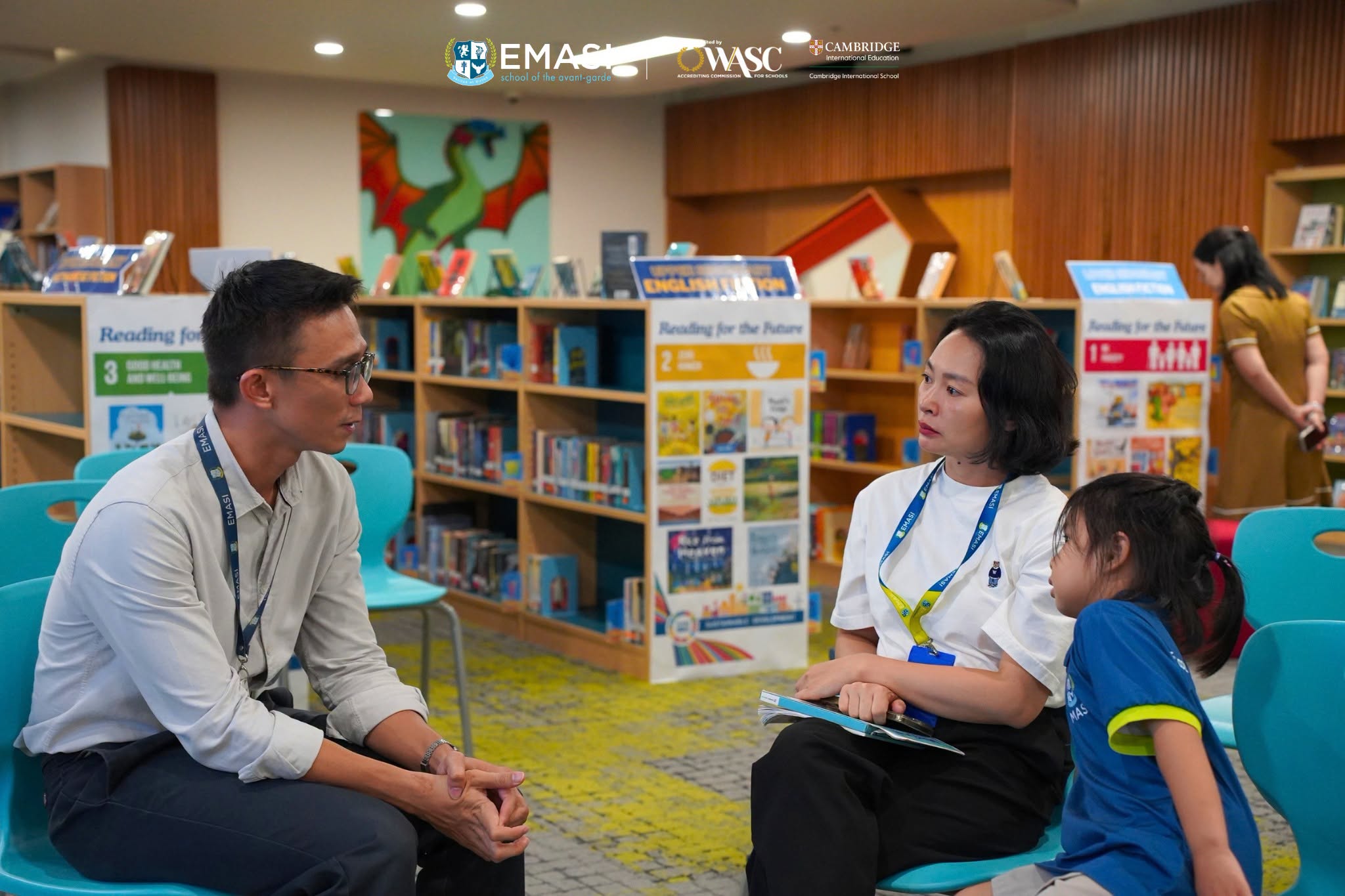
EMASI’s English program is built around four checkpoints that follow a student from their first Cambridge Young Learners shields in Primary through to A-Level and IELTS readiness by graduation. Recently at our Secondary Afternoon Tea meeting, Mr. Cory, our English Subject Lead shared what this pathway looked like in our Secondary School. Below, we will explain what it means for the school as a whole.
Early Years: Our youngest learners focus on the fundamentals of communication and socialization skills. As students progress through Early Years, there is a focus on laying the foundations of early literacy and phonemic awareness. Our aim is to have students leaving Early Years who can communicate fluently verbally whilst been able to read and write at an age-appropriate level.
Primary: In the Primary, our students follow the Cambridge Global English course. Cambridge Global English allows our students to develop both academic and functional language proficiency. This is measured through Starters, Movers, and Flyers, aiming for at least 12 of 15 shields. Students also complete the Cambridge Checkpoint in Grade 5. By the end of Primary, the goal is a minimum CEFR level of A2.
Primary to Secondary transition: From Grade 1 through to Grade 8, every student follows the same Cambridge Global English series, so the move into Secondary feels like continuity, not a reset. Again, we are focusing on developing the language proficiency levels required to be successful both academically and socially. We measure our students’ success by through Cambridge Checkpoint assessments and the PET and KET assessments.
Grade 9 readiness: By Grade 9, students aim for B1 to B2, with B2 as the stronger target — the level needed to follow complex IGCSE texts and explain ideas fluently.
Two pathways, one goal: At EMASI, our students have the benefit of choosing the correct pathway to support their future ambitions. After Grade 8, students choose between the international pathway (Cambridge IGCSE and A-Levels) or the bilingual/MOET pathway (National Geographic Learning Perspectives plus IELTS preparation). We are proud to treat both as equally valid routes — not a “main path” and a fallback — reflecting EMASI’s missionVision and Mission to support our students’ development in Vietnamese and English rather than one language track at the expense of the other.
University readiness: IELTS scores of 6.0–7.5 are typical for international university entry, with Cambridge exams like KET and PET along the way giving families external, independent evidence of progress. Thanks to the outstanding bilingual education provided, graduates from EMASI attend international universities ranked in the global Top 50 as well as prestigious local universities.
Why Bilingualism Matters More Than the Exam Score
When we look at the grades and benchmarks, it is easy to see English language learning as exam preparation. However, it is really something bigger — and it connects directly to EMASI’s founding philosophy of humanity, patriotism, and liberalism and its mission to foster global understanding, respect, and independent learning.
Cognitive benefits
Research over the years continues to link bilingualism to stronger executive function — focus, task-switching, filtering distractions — because children who operate in two languages daily get constant practice in choosing the right system for the moment. Bilingual learners also tend to show greater cognitive flexibility and a sharper intuitive grasp of how language itself works.
Cultural and personal benefits
We understand that a student fluent in Vietnamese and English does not just gain a skill — they gain a bridge. This is bilingual education in service of EMASI’s mission: producing graduates who carry Vietnamese values into a global context, rather than choosing between the two. This creates a true sense of pride in who we are.
Long-term benefits
We know that strong English skills and proficiency open success at IGCSE and A-level, competitive IELTS scores, and international university options. Beyond academics, bilingual EMASI graduates move more fluidly through international workplaces and multicultural teams — independent, self-motivated learners exactly as EMASI’s mission intends.
The Real Message Behind the Benchmarks
Every checkpoint in this pathway — the shields, the CEFR grades, the exam scores — exists to help teachers support and celebrate each individual at the right moment. As Mr. Cory so rightly said in his presentation: benchmarks guide decisions, they do not define potential.
That is not just a nice sentiment. It is the practical expression of how teachers and EMASI deliver academic excellence and personal growth, in two languages, for our students.

Frequently Asked Questions
What CEFR level should my child reach by the end of Primary at EMASI?
A minimum of A2.2 is the target for a student who has studied at EMASI for 4-5 years. However, we expect many of our students to exceed this level.
What’s the difference between EMASI’s international and bilingual/MOET pathways?
Both continue building English after Grade 8. The international pathway uses Cambridge IGCSE and A-level materials; the bilingual/MOET pathway combines the national curriculum with IELTS preparation. Neither is a “backup” track.
What IELTS score do universities typically require?
Most international universities ask for 6.0 to 7.5, though exact requirements vary by institution and program.
Why does EMASI emphasize a dual language approach?
It reflects the school’s mission to deliver an education that emphasizes Vietnamese values, academic and personal excellence, and fosters global understanding, respect and independent learning in both English and Vietnamese.
Have question about EMASI Nam Long’s English Pathway? Let us know through the form below.